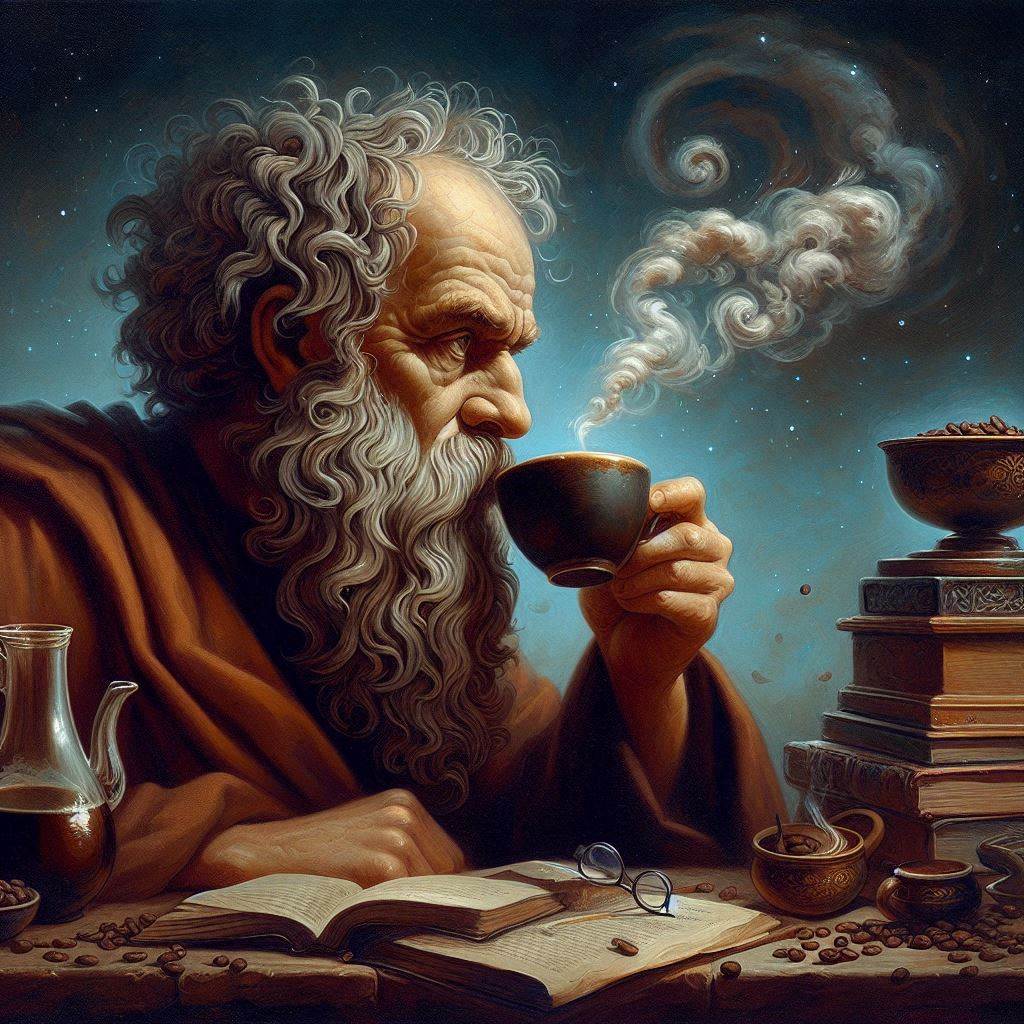
The Symposium is one of Plato’s most beautiful dialogues. According to the historians of philosophy Reale and Antiseri, it is «the literary masterpiece of Plato’s maturity». The title refers to a practice widespread in ancient Greece.
Etymologically, the word means “drinking together”. After dinner, people would spend time drinking, enjoying one another’s company, and discussing a variety of subjects, often matters of great importance.
In this sense, this “drinking together” represented – and still represents for us as readers – a practice with a profound educational value:
«And had we not also said that in such circumstances [the ‘symposium’] the souls of the drinkers melt together like iron, and thus become more malleable and return to a childish state, so that they become an easy object of education in the hands of one who can and knows how to form and shape them, just as if they were young?» (Laws, 671 b-c)
The symposium in which Socrates takes part is narrated by one of his disciples, Apollodorus, who in turn recounts what he had been told by another disciple of Socrates who was present at the banquet, Aristodemus:
«Well then, these speeches were approximately as follows […] Or rather, I too shall try to tell them to you from the beginning, just as he told them to me» (Symposium, 174a)
Besides Socrates, the protagonists of the dialogue are the physician Eryximachus, the comic poet Aristophanes, Pausanias, Phaedrus, Agathon, and Alcibiades, who appears almost at the end. At Eryximachus’ invitation, each of them is to deliver a speech on Eros – or, more precisely, a eulogy of Love.
Aristophanes’ speech is particularly interesting: it has an anthropological character. According to the comic poet, human beings are divided, and in this life they are compelled to search for their lost half.
Love is nothing other than this aspiration toward a lost fullness:
«And the reason for this is that this was our ancient nature, and we were whole. Therefore the desire and pursuit of the whole is called Eros. At first, as I said, we were one; but now, because of our wrongdoing, we have been separated from one another by the god» (Symposium, 193a).
Yet the highest point is reached, ça va sans dire, by Socrates, who shifts the discussion from the rhetorical level to that of truth. By recounting the words of the priestess Diotima – and thus giving his intervention a sacred dimension – he seeks to grasp the essence of Love, its very nature.
Eros is a daimon and, as such, stands between gods and human beings: he is the son of Poros (Abundance) and Penia (Poverty).
In this sense, Eros is like the philosopher, who does not yet possess knowledge but desires it:
«Therefore Eros must be a lover of wisdom and, as a lover of wisdom, he must stand between the wise and the ignorant. And the cause of this is his birth: for his father is wise and resourceful, while his mother is neither wise nor resourceful» (Symposium, 204a).
Eros is what drives human beings toward the possession of their true Good (205 e); it is what drives them toward the possession of that which endures forever: the finite seeks the infinite, the mortal seeks the immortal.
In the central part of the speech, this becomes a genuine metaphysical ascent – the famous “ladder of Eros” – which reaches its highest point in Beauty itself:
«Whoever has been educated up to this point in matters of love, contemplating beautiful things one after another and in the right way, will, as he approaches the final stage in the things of love, suddenly behold something wonderfully beautiful in its nature. […] First of all, something that always is, that neither comes into being nor perishes, neither increases nor diminishes; and which is not beautiful in one respect and ugly in another, nor beautiful at one time and ugly at another, nor beautiful in relation to one thing and ugly in relation to another, nor beautiful in one place and ugly in another, as if beautiful for some and ugly for others. […] Rather, it will manifest itself by itself, with itself, through itself, as a single eternal form» (Symposium, 211a).
After Socrates’ speech, Alcibiades enters the scene. Drunk, he begins his speech not about Eros, but about Socrates. Alcibiades presents a conception of Eros that is radically different from the one just described – a conception that Socrates harshly criticizes.
Human beings cannot conceive of love, and therefore of wisdom, in utilitarian terms or as a form of exchange, as Alcibiades does.
In conclusion, what must be avoided is «exchanging weapons of gold for weapons of bronze» (219a), and we must instead begin to philosophize together with the sole purpose of reaching truth, goodness, and beauty, thereby grasping the true nature of Eros.
Giovanni Covino


Rispondi